Showing posts with label Lauren. Show all posts

0

A Lost City

Posted on Wednesday, June 19, 2013


If I heard “Macchu Pichu” five days ago, the first thought that would come into my mind was “oh, the lost city that looks like a maze made of stone.” As a group, we traveled about 12 hours for the trip to Macchu Pichu. I was not too sure what it would be like, despite my preconceptions. After our first 6 hours of travel, we hiked about ten minutes up a winding stone path and I was rewarded with the most breathtaking site I have ever seen in person. To me, Macchu Pichu looked like I was watching a movie on a huge screen and its beauty was not real. I was definitely wrong. Besides its beauty, Macchu Pichu holds serious history between its stones.

The Lost City known as Machu Picchu 

This is known as Machu Picchu to tourists, but to indigenous people, the city that this mystery is located in in called Machu Picchu. According to Valentine, our tour guide, the highest mountain in this picture is called “Young Mountain” and the mountain directly behind me in this picture is called “Old Mountain.” This region is known as “The Lost Incan City.” According to Valentine, this area is not composed of Incan “ruins”; it is a city.

According to Valentine, no current historians truly understand the purpose for this city. Many people believe that this city was used as a safe sanctuary for the Inca elite. Valentine explained that there were originally only 8 entrances to this site built in a valley surrounded by Andes Mountains. This area is also known as the beginning of the jungle.   Interestingly, archeologists have only found 5 trails into the city. Three of these paths are currently used by tourists. The remaining two paths lead to different cities and require nearly a week of travel. Also according to historians, these paths were small and hidden for defense purposes. For instance, there was a lookout point for this city and if there was an intruder, it would be easy to stop because Incans would be able to see them early.
The Sacred Rock

This rock is known as the “sacred rock.” Our tour guide asked us to pick the most sacred animal in Peru, and that was what this natural rock represented. The animal is guinea pig! In the valley of Macchu Pichu, the Incans worshiped this natural rock
formation as guinea pig.
Baby Llama

This area has become extremely tourist-centered. As you can see in the picture above, there were animals that were people-friendly. This is a baby llama that hangs out and walks around with people. Additionally, there are tours going on constantly. One frustrating thing about our tour was that I could hardly take pictures or see things because there was another tour group (or two) looking at the same thing. At the bottom of the city of Machu Picchu, venders sell post cards, authentic Peruvain goods, and food. Although this lost city is crowded by tourists, it does benefit the country from a monetary viewpoint. According to the travel website Peru: Empire of Hidden Treasures, Macchu Picchu is “the most important and beautiful legacy of the ancient Peruvian, is part of the Historic Sanctuary of the same name, which is also one of the few places in the Americas placed on both the World Cultural and Natural Heritage Lists by UNESCO.” This area attracts many tourists each year, creating revenue for the country of Peru. I definitely recommend visiting this amazing site of the lost city, and explore the magic behind the stones. 


Lauren

0

Toilet paper: the unknown precious commodity


Ethnocentrism: a word we as a nation rarely think about until forced to. Ethnocentrism embodies an attitude that glorifies one’s own society. According to Ken Barger, ethnocentrism can be defined as “making false assumptions about others’ ways based on our own limited experiences”… “we don’t understand that we don’t understand.”

Before we left for Peru, we met as a group several times to talk about any concerns or questions regarding our stay throughout the first two weeks of June. Some questions regarded the campecinos that we would be staying in.

Will they have blankets?

Yes

Will they have beds?

Yes

Will they have a toilet?

Yes

Will it be warm?

Yes

After about three hours, our concerns were diminished. From my perspective, concerns grew like wildfire the millisecond that we pulled up to our future housing. From the highway, we could not see any nearby housing. Gabby, Claudia, Kristin, and I were instructed to follow the pathway up to the house. We traveled downhill slightly and crossed a bridge over a river. We continued up a seriously steep, single-file line path of rocks, crouched under trees, and over tree stumps. After a roughly seven minute hike, we arrived at our destination. A little red door led to a dirt-floor patio. At the middle of the patio was a multi-purpose sink with four doors facing towards the sink. One door led to our four bed bedroom. The day went on and we returned to sleep. The first sign of ethnocentrism: assuming that because the family had a “toilet” they had toilet paper to accompany. Not every family had a traditional toilet that we, as Americans, pictured in our minds. Some families had holes in the grounds for their bathroom. Additionally, we assumed that toilet paper would naturally accompany an outhouse, hole, or toilet but quickly learned to carry a roll with us wherever we went. We did not ask the people if they used toilet paper, or what they used to clean themselves. The two foregoing examples show that we clearly did not know what we did not know; we were in the light of ethnocentrism.
This is an extremely nice building as personally compared to other buildings seen in this area. It was common to have adobe bricks, without adobe to insulate the bricks. It also was common to have dirt floors and outhouses. These are all assumptions based on experiences and houses seen throughout the tour of the area. 


After the first night, breakfast the next morning was spent under blankets. The night before was so cold that we were still stunned from the temperature and the fact that these rooms were “heated” and “warm” rooms. Needless to say, the majority of us were ill-prepared for the near-freezing night under three wool blankets. The interesting thing about this experience is two-fold. i) We were given the opportunity to experience the life many people lead in the campecinos of Peru. ii) We fell guilty to ethnocentrism again: we assumed there would be a heated room, just as we heat our homes in the winters of Omaha, and a warm bed to sleep well. The second night’s sleep was better, although we were guilty of ethnocentrism as a whole group.

This is the second night of rest in our home, which was pegged as the "warmest house" of all the Ccaijo projects, according to Juan Carlos. This was a great experience. This is a picture of me in a small sleeping bag on my bed. 
To reiterate, ethnocentrism is an assumption by people who “do not know what they do not know.” I feel guilty to the concept of ethnocentrism several times, even before the trip began. For instance, why didn’t any student ask “Do they have toilet paper?” It is because we had no honest realization of the standards in Peru: we did not know what we did not know.

0

Dance speaks no language

Posted on Sunday, June 9, 2013

8 June 2013
The Incas are a vital part of Peruvian history. So far, we have been to three separate museums that highly revere the Incas. Their history is vast and detailed, and is extremely important for understanding the way Peru is today. I have personally observed (several times) one piece of the Incan history that has not died: dance.
Dance was used for celebration. It was also used for expression among the peoples in Peru. The dances had begun in the 1900s and brought to town by artisans and craftsmen from the countryside. Different groups of people danced different dances and more dance styles were being created throughout the times of celebration and times spent together as a community. Although women could participate in dancing, most dances were performed solely by men. Dances were used to express community among urban barrios and also used to divide among rivalries and express tensions. For instance, Dr. Kolak told us the story about a war between the Spanish and the Incas. The Spanish arrived at the front steps of the Incan power house. When the Spanish arrived on their horses, they declared war on the Incas. As a response, the Incan nobles began a fabulous dance meant to intimidate the Spanish and their horses away from war. The opposite occurred and the Incas fell to the Spanish in that war. In 1920, the dances began to die as a result of trade guilds. Trade guilds prevented an “organizational base for the performance of the dances” (Wilson, 2006). Between the 20s and 30s, Inca history slowly disappeared in response to while rule. The white rule limited urban popular culture and replaced this with new cultural activities with “hybrid identities under formation” (Wilson, 2006).
At El Museo Larco, there are statues of Incan emperors with traditional jewelery. Variations in hats, earrings, nose rings, and necklaces told others their status in the empire and where they originated from.

Throughout my short week in Lima, I have experienced three different instances that show the Peruvian tradition of dance is still alive and well. On Wednesday night, we had the opportunity to attend  Brisas del Titicaca, which is a tourist attraction showing the cultural dances founded at Titicaca. Here, performers dressed in exuberant garb and flashed their arms and legs around to a beautiful beat. They acted out certain events that included the King, commoners, and a joker, as explained by Wilson (Indians and Mestizos). The following day, we attended El Museo Rafael Larco Herrera, which had an expansive collection of Incan artifacts. One section was dedicated to the jewelry of dance. Earrings, necklaces, and nose rings were worn to explicitly state what region you were from and your position in the Empire. Friday night, we attended Del Carajo and enjoyed a more modernized form of dance for ourselves. The most important things about all of these experiences are as follows: i) history will always be, ii) history helps us explain the way we are or how something functions in today’s society, and iii) dance speaks no language. Regardless of when something occurred, we may still have the opportunity to study history and see it throughout the culture today. Although we did not live throughout the time of the Incas, we can still see their effect on Peruvian history today. Lastly, despite the language barrier, we were all able to understand the dance and its meaning in conjunction with Peruvian and Incan history. We were even able to dance with locals and enjoy ourselves dancing in a modernized way. Dance speaks no language.

Dancers perform Waka Waka at Barisas del Titicaca
"Dance is the hidden language of the soul."
-Martha Graham


Buenas Noches Mundo,
Lauren

0

Jaw-dropped and Humbled

Posted on Friday, June 7, 2013


6 June 2013

My time spent in Lima so far has been extremely eye-opening. Lima is a beautiful, but dirty and populated, city. Although these first few days have been exciting and jaw-dropping, I cannot wait for what the next several days will bring for me. 
We ate breakfast at 730am. It was the normal Peruvian breakfast: bread and butter or jam. Coffee, tea, and water were available to drink. The majority of the day was spent at the University Antonio Ruiz de Montoya. To begin, we took a tour of the university. It seemed similar to Creighton University in Omaha. About 1,000 students attend UARM for a regular school year. They run their school year similar to quarters with a long summer break and long Christmas break, opposite of our semesters. Because Peru is located on the southern hemisphere, the seasons are opposite of the United State's seasons. We listened to a lecture about the history of Peru and the Jesuits from Dr. Jeff Klaiber, S.J. Dr. Jeff  Klaiber, S.J. is from Indianapolis, Indiana. His lecture pulled out several key aspects from our lecture material to prepare for our travels during Peru. A few major events that Dr. Klaiber, S.J. spoke about the Jesuits in Peru. The Jesuits were expelled from Latin America and Spain in 1767. In 1773, Pope Clement XIV suppressed the Jesuit order, which was more of a political movement compared to a theological movement. 1971 marks the beginning of liberation theology. Dr. Jeff Klaiber, S.J. teaches history at UARM and guest-lectures at the nearby Catholic university. This is especially important to our trip in Peru because it allows us to understand the history behind the way Peru is today.

This is UARM's coat of arms. Father Juan Dejo explained that this arm is standardized between all Jesuit universities. The difference between the shields is between the top left hand corner. UARM has three crowns in their shield because it was founded during the time of the Three Wise Men. 

After Jeff, Dr. Kolak continued with lecture regarding more biology information. He spoke about water sheds and microvertebrates. He focused on our plan for water testing and the characteristics of Lima, Cusco, ocean, and the mountains. Following Dr. Kolak's lecture, we went to lunch which was one eye-opening experience. Elizabeth and I were the students who translated for the rest of the group. The opportunity to hear Spanish and respond in Spanish to indigenous people is amazing. To me, it is literally inexplicable how amazing it feels to speak two languages. The opportunity is priceless so I thoroughly enjoyed translating and learning more Spanish. Lunch was enjoyable and most of us even enjoyed desserts as well. Following lunch, Dr. Davis bet me that if we won volleyball against the other students, then we would not have lecture later. The challenge was accepted. The science lectures were as interesting as the history lecture by Dr. Klaiber. These lectures are vital to our trip because it will increase our knowledgebase about a platform of our trip: water. Our professors taught us about the basics and complexities of toxicity, immunology, and the water quality in Peru. This helps all of us understand one of the reasons of why we were given this opportunity to travel and study in Peru. We can now appreciate our abilities to speak with locals and potentially help the city's water situation simultaneously.


Courts made of cement are common throughout Lima. I have only seen a few soccer fields made of grass. This is expected as Lima is in the center of a desert. This court triples as a volleyball court, soccer field, and basketball court. This court is in the center of the University.

Elizabeth and I asked the students if we could play volleyball with them and they were so welcoming and allowed us to play immediately! We lost the very first game but over time, we won. (Dr. Davis lost the bet.) We played volleyball for roughly three hours. I learned a lot of new words in Spanish like "fuera" which means out, "dentro" which translates to in, and "cancha de voleibol" which means volleyball court. It was extremely interesting to play volleyball with students. These students barely knew English and most do not study English at the university. At UNO, I did not have an opportunity to learn words about sports. I realize that there are many words that I have never considered speaking in Spanish, or needing to know. For instance, I never needed to know how to say "nice hit!" except for today. In Spanish, you say "Buen Mate!" After volleyball, we did listen to Dr. Davis lecture for about an hour. To me, it was all interesting. He focused on how altitude affects your body and its functions. Cusco is nearly 11,000 feet in altitude, quite a difference from the sea level that we were at right now. He said that knowing what is happening in our bodies will help us get through the mental half of the high altitude ;). Playing volleyball with locals was, and probably will remain, one of my favorite moments in Lima. This unexpected opportunity allowed us to drastically increase our confidence and abilities to speak Spanish.

For the remainder of the night, we ate a delicious dinner at Cafe Mango near the ocean in Miraflores. It was absolutely wonderful and delicate. I ate a dessert, similar to a cream puff, that was shaped like a swan in a chocolate lake.  After enjoying each others company and dinner, we walked around Larcomar, the outdoor shopping mall near the ocean. The sights were breathtaking. This situation was kind of a paradigm. We experienced one of the poorest areas of Lima, Ate, and then one of the richest and most beautiful areas of Lima, Miraflores.

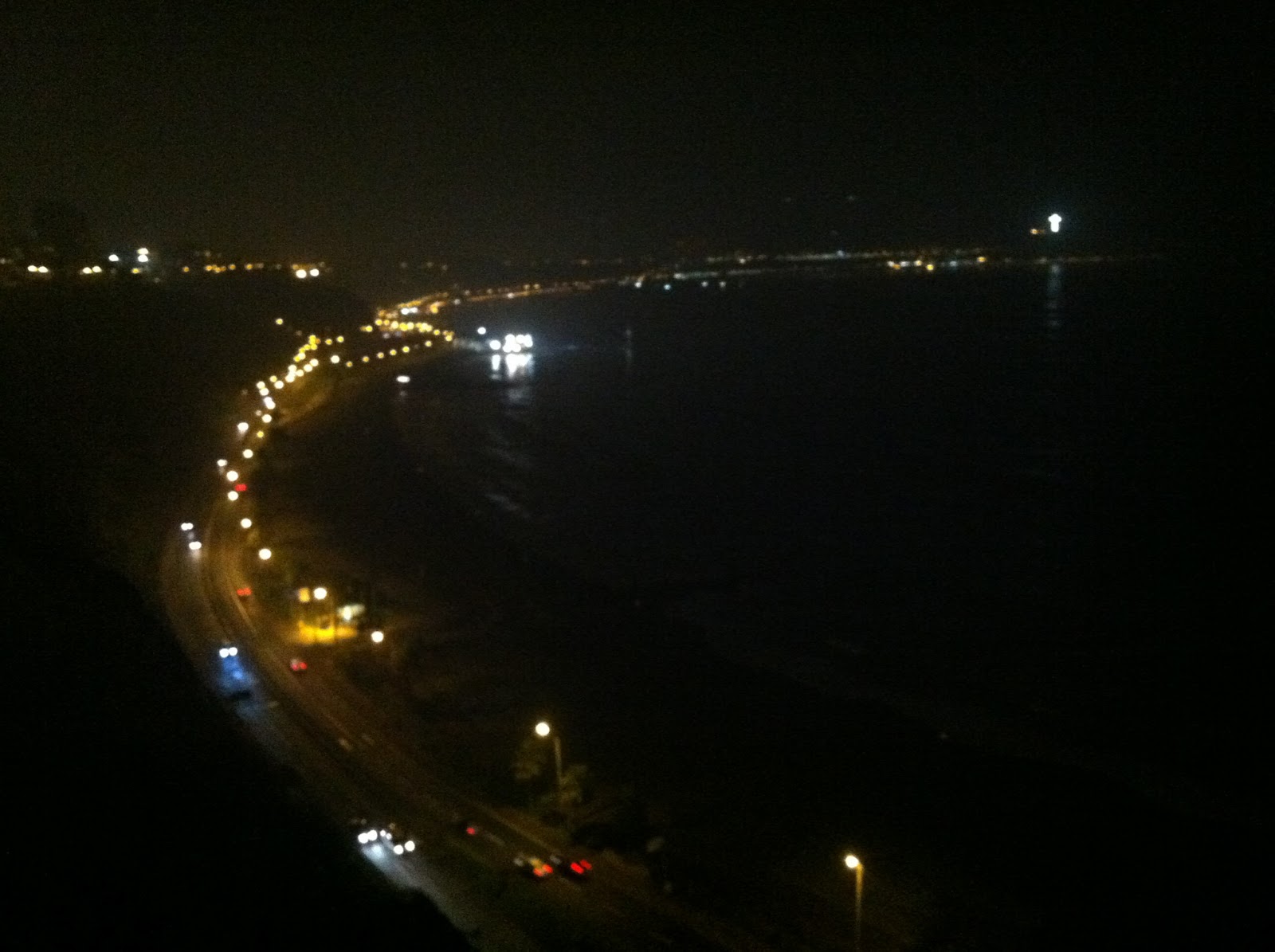
This is the view of the ocean from Larcomar. To the left is a cliff, nearly straight down. There is a highway that runs along the ocean. To the upper right, Lima continues to more neighborhoods. At the end of the peninsula, there is a glowing cross that is idolized by Peruvians. There are a few crosses dedicated to several saints throughout the city. 
On Sunday the 2nd, we walked around downtown Lima as a group. This relates to the title and my opening paragraph. Words cannot describe how jaw-dropping and humbling the experience felt for me. The most crowded city I have visited is Denver, Colorado, which inhabits nearly 620,000 people. Denver is roughly 400 km^2. Lima inhabits nearly 9,000,000. Lima is roughly 805 km^2. As a group during a debriefing session, we concluded that the streets of Lima were extremely clean. We saw more people sweeping up the cement and caring for their city more so than in the United States, presumably speaking. On the contrary, graffiti dramatically covered the walls of businesses, houses, and streets in every direction in Peru. One student tour guide from UARM, Frederico, said that Lima does not have enough police force to stop or clean up the graffiti around the city. In Omaha, I see virtually no graffiti around the city. There is an area in Lima known as Ate, that is the poorest area I have seen. Surprisingly, it is not the poorest area of Lima. Our professor, Dr. Celle, informed us that only 10% of inhabitants in areas outside of the richest areas (two neighborhoods) pay municipal taxes in Lima. According to what we learned during our lecture before Peru, we learned that 33% of Lima is below the poverty line. According to the U.S. Census Bureau, there are 15.5% of inhabitants below the poverty line in Omaha, and  18.8% of people in Denver are blow the poverty line. People in America may be able to compare and contrast the city statistics to try and understand Lima as a city. I am often overwhelmed in both cities because of the population. To me, its amazing to see that nearly 7x more people live in Lima, per square kilometer, than in Denver. Walking through downtown, street vending is quite common, and presumably the only monetary support for these people. I assume that there are a lot of people downtown and in Ate in a poor situation. Vending in small stores and in kiosks seem to be extremely common in Lima, especially downtown. In Ate, families often have to travel down the mountain for certain goods. This experience was especially jaw-dropping and humbling because I was able to compare and contrast different ideas learned throughout lecture to an actual real-life event. I am brought back to my life in the United States for a quick minute, and rapidly return to Lima: truly jaw-dropping and absolutely humbling.


Hasta Luego,
Lauren Dahlquist

Powered by Blogger.